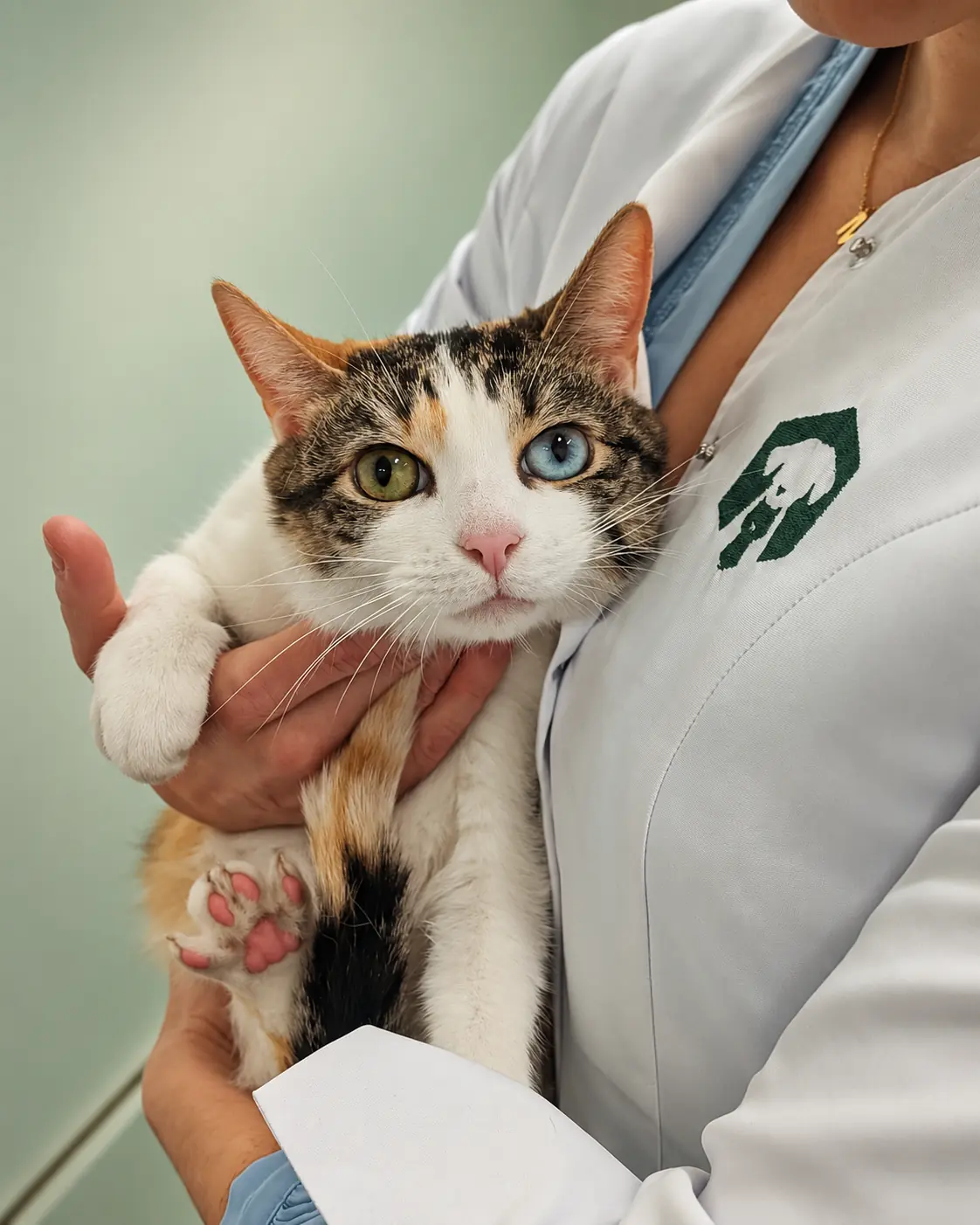
Feline Medicine in Porto
A consultation designed for cats, not adapted from dogs
Cats hide illness until late and find the journey stressful, which means many only reach the consulting room once the signs are obvious. The feline medicine consultation exists to turn that around: calm handling, an examination adapted to a patient who dislikes being restrained, and attention to the diseases that are specific to the species.
- Handling adapted to cats
- By appointment only
- Same-day tests
Book an Appointment
Book online, right here on the site, in under two minutes.
- An unhurried consultation, with a calm approach
- A full examination adapted to the species
- Plan and costs explained before going ahead
Select “Consulta veterinária” in the form.
Book a veterinary consultation ("Consulta veterinária" in the calendar) and mention that it is for a cat. If your cat finds the visit particularly stressful, tell us when booking so we can arrange the quietest possible time.
- Years of experience
- 15Years of experience
- Satisfied clients
- +3500Satisfied clients
- Happy pets
- +4200Happy pets
Handling adapted to the species
Less restraint, more time, controlled light and sound, and the examination done inside the bottom half of the carrier whenever the cat would rather stay there. A tense cat gives you a false blood pressure and a false heart rate.
Appointments to keep the wait short
We work strictly by appointment, and that matters more to cats than to any other patient: it means there is no waiting room full of dogs between arriving and being seen.
Attention to the diseases of the species
Chronic kidney disease, hyperthyroidism, diabetes, urinary disease and dental disease are all common in cats and set in quietly. They are precisely the ones worth looking for before there are any signs.
How a consultation for a cat works
The aim is a complete examination without turning the visit into an experience the cat comes to associate with the worst.
A conversation before touching the cat
We start by talking to you while the cat settles into the room. We ask about food, water, the litter tray, weight and what has changed in the routine at home.
A calm approach, at the cat's pace
We leave the carrier open and wait for the cat to come out on its own. When it would rather not, we take the top off and examine it in there, where it feels safe.
Full physical examination
Weight and body condition, mouth and teeth, abdominal palpation with attention to the kidneys and the thyroid, skin and coat, and listening to the heart and lungs.
Tests when they make sense
From seven years old, and whenever there is weight loss, increased thirst or frequent vomiting, blood and urine tests are what detect kidney and thyroid disease before the signs are visible.
A plan explained and recorded
We explain what we found and what we recommend, with costs, before going ahead. It is all recorded in the Digitail app, including the weight, which is the most useful figure to compare between consultations.

Signs in a cat that warrant a consultation
Cats compensate for illness for a long time. By the time a sign is obvious, the problem has usually been there a while.
- Drinks more water, or urinates more than used to be usual
- Has lost weight, even while still eating
- Goes to the litter tray often, or has started urinating outside it
- Eats more slowly, drops food or has bad breath
- Has stopped jumping to places it used to reach effortlessly
- Hides, interacts less or has stopped grooming as before
- Vomits frequently, and not just the occasional hairball
- Is over seven years old and has never had routine blood work
Veterinary Team
A permanent team and collaborating veterinarians, with Marta Barros ensuring the regular clinical follow-up of our patients.
We care for every patient closely and individually, focused on prevention and careful diagnosis.
We combine clinical knowledge with an empathetic approach, always with transparency and trust.

What pet owners say
Real reviews left on Google by people who have been here.
Average rating
Google Reviews
“I think the team was great, it was her first bath and she can get very excited. She seemed happy after the bath and the team took great care for her.”
M W (Edgy Hamster)
April 2026
“Muito atenciosos e educados. Todos foram excepcionais, principalmente a menina que me atendeu na recepção, e a veterinária. O cuidado com a minha gatinha, sempre muito pacientes e prestativos, disseram-me toda a informação que eu precisava de saber.”
Karen Farias
March 2026
“Excelentes profissionais e a clínica é muito tranquila. Sem tempos de espera. Conseguem aliar o rigor científico ao cuidado afectuoso. Agradeço a toda a equipa que atendeu a Ba e a Bel no sábado. Chegaram tranquilas a casa e estiveram sem nenhuma queixa. Apreciei tudo e recomendo.”
Cristina de O. Alves
January 2026
Frequently asked questions
8 questionsHow do I book a consultation for my cat?
Book a veterinary consultation ("Consulta veterinária" in the calendar) and mention that it is for a cat. If your cat finds the journey particularly stressful, tell us when booking so we can arrange the quietest possible time.
My cat panics at the sight of the carrier. What can I do?
Leave the carrier open at home in the days beforehand, with a familiar blanket inside, so it stops being an object that only appears before a vet visit. In the car, cover the carrier with a cloth, and avoid feeding your cat in the two to three hours before.
How often should a cat see a vet?
Once a year for healthy adult cats. From seven years old we recommend every six months, with blood work, because that is the age at which kidney disease and hyperthyroidism start to appear.
My cat never goes outside. Are vaccines really necessary?
Yes. Some agents come into the house on clothes and shoes, and one brief escape or one stay in hospital is enough for exposure. The plan is adjusted to the lifestyle: an indoor cat does not necessarily need the same as a cat with access to the street.
My cat eats well, so is everything fine?
Not always. A cat with hyperthyroidism can eat more than usual and still lose weight, and a cat with early kidney disease often keeps a normal appetite. Weight and blood work detect what appetite hides.
Why is my cat urinating outside the litter tray?
It is a sign to take seriously, not a behaviour to correct. It can indicate infection, crystals or a urinary blockage. In a male cat straining without producing urine, it is an emergency: call 223 239 804 immediately.
Do cats wait in the same room as dogs?
We work strictly by appointment, precisely so the time between arriving and going into the consulting room is short. If your cat is especially reactive, let us know when booking.
Do you spay cats?
Yes, with a pre-surgical assessment and pre-anaesthetic blood work. It has a page of its own, with the whole process explained.
Select “Consulta veterinária” in the form.
Our Pet Friendly Clinic in Porto


Book your pet's appointment
Every pet is different: we assess the case before setting a plan, and costs are explained before going ahead.
Select “Consulta veterinária” in the form.